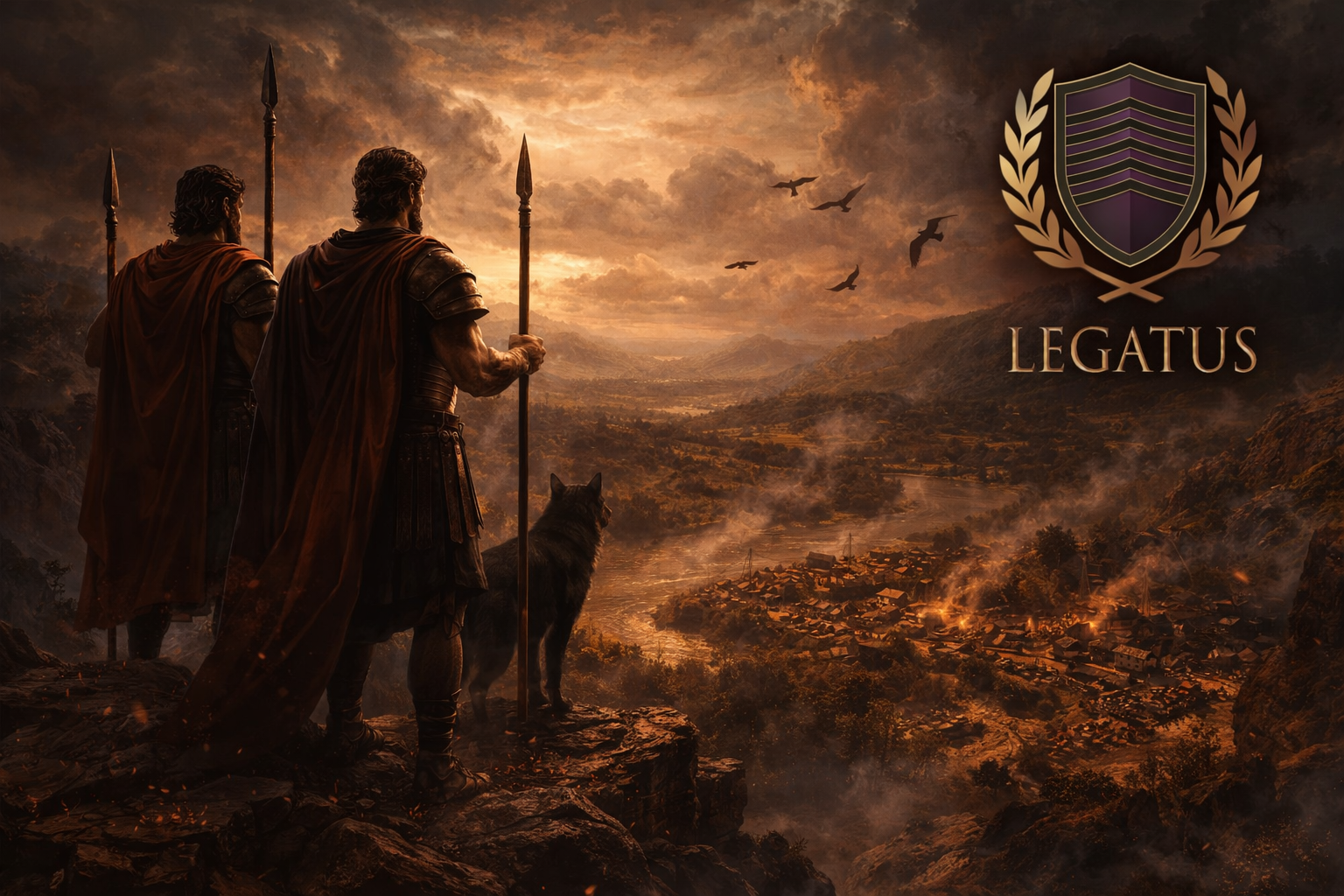
The story of Rome does not begin with a great dream, but with an injustice.
In the city of Alba Longa, King Numitor was usurped by his brother Amulius, taking power by force. Amulius decided to forge his rule through fear and to secure the throne, he eliminated any potential heirs. Numitor's sons were killed, and his daughter Rhea Silvia was forced into a lifestyle that would prevent her from having children. Despite this, she managed to give birth to twin sons: Romulus and Remus.
Amulius ordered the babies killed, but instead of executing them, his servants placed the twins in a basket and let them wander the Tiber River. The river carried them to safety, where they were found and nursed by a she-wolf, before being found by the shepherd Faustulus and raised by his wife.
From the moment they were born, the twins lived outside the protection of power. Their survival was not guaranteed by law or status, but depended on their own endurance, as well as the kindness of other people. This early life, far from comfort and the corrupting influence of authority, gave them a primordial freedom.
Romulus and Remus grew up to be strong, disciplined young men. Raised among shepherds, they learned order through work, responsibility through routine, and leadership through rank. Their influence came not from title, but from reliability and ability. These virtues would later define the structure of Rome.
Over time, conflict with local rulers and herders brought the brothers into contact with Alba Longa, and they soon discovered their true origins. Faced with this knowledge, Romulus and Remus decided not to remain silent. Driven by courage, they gathered support, returned to the city, and overthrew Amulius.
However, after their victory, the brothers did not take over Alba Longa. In a show of honor, they returned power to Numitor, the rightful king. After restoring order, they decided to found their own, new city. Rome was not built by theft or inheritance, but from the ground up.
The brothers chose a spot near the Tiber, where their lives began, as their founding site. When a disagreement arose over leadership, they did not resolve it by force. In their wisdom, they turned to divination, a sacred Roman practice used to interpret the will of the gods. Remus was the first to notice the signs, seeing six birds. Romulus later noticed twelve. Although interpretations of this practice vary, legend has it that Romulus’ sign was victorious in every case. Through this process, authority was not imposed by brute force, but was affirmed by ritual and order.
Romulus thus became the founder and king, and soon began marking the sacred boundary of the city. Rage simmered within Remus over his defeat, which led him to cross the boundary. This act led to his death. Whether this was at the hands of Romulus or one of his soldiers depends on the source.
Rome became Rome not because it was born pure, but because it was born with a clear purpose. Its founding myth is not without violence, but it serves as a reminder that boundaries matter, that legitimacy matters, that consequences matter. It insists that even the strongest man must learn to rule himself before he can rule anything else.
That's what lies at the core of Legatus: not noisy luxury, not empty aesthetics, but quiet authority. Authority that is deserved. Authority that lasts.